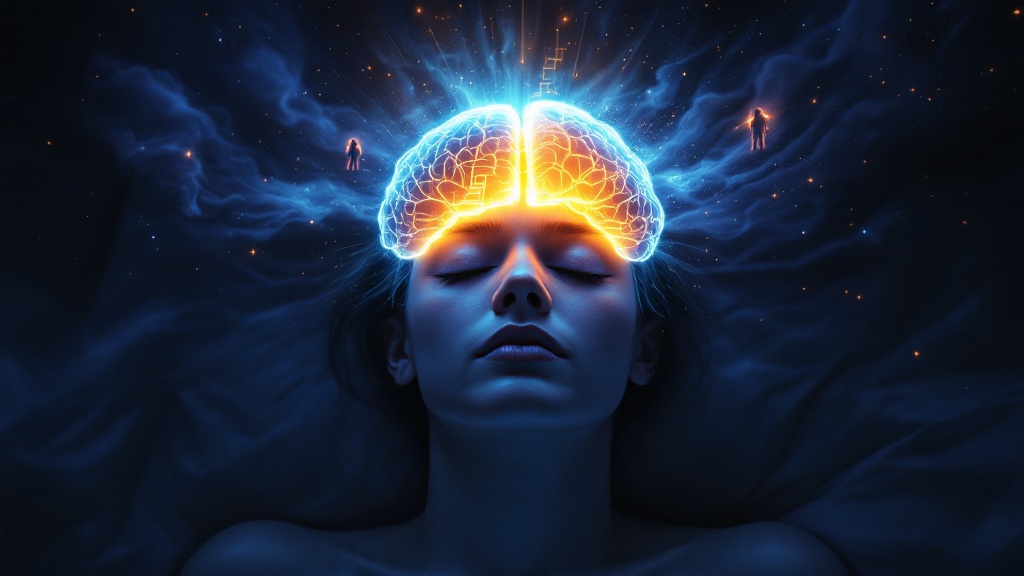
Why Do We Dream? A Short Answer From Science
Dreams happen mainly during REM sleep, a stage where your brain is almost as active as when you are awake. During this time, the brain replays memories, processes emotions, and generates vivid mental experiences. Most sleep scientists believe dreams serve memory consolidation and emotional regulation functions. No single theory has won universal agreement yet, but the science points clearly to the brain doing important work while you sleep.
Science does not have one final answer on why we dream. What it does have is a growing set of well-supported theories, and each one reveals something useful about the nightly experiences your brain creates. This article walks through those theories in plain language, then connects them to why dream meaning and symbolism still matter as a tool for self-reflection.
What Happens in Your Brain While You Dream
Understanding the neuroscience of dreams starts with knowing which brain regions light up during sleep. Here is a plain-language breakdown of the key players.
Key terms defined:
- REM sleep (Rapid Eye Movement sleep): a recurring stage of sleep, first identified by researchers Nathaniel Kleitman and Eugene Aserinsky in 1953, during which your eyes move rapidly under closed lids and most vivid dreaming occurs.
- Amygdala: an almond-shaped region deep in the brain that detects and responds to emotional experiences, especially fear and threat.
- Hippocampus: a seahorse-shaped region in the brain’s temporal lobe that stores and retrieves memories.
- Prefrontal cortex: the front part of the brain responsible for logic, planning, and self-control.
- REM atonia: the temporary muscle paralysis that prevents you from physically acting out your dreams during REM sleep.
During REM sleep, the amygdala and hippocampus stay highly active. That is why dreams feel emotionally intense and often resemble fragmented memories. The prefrontal cortex, by contrast, goes quieter. Its reduced activity explains why dream logic feels perfectly normal while you are in the dream, even when the scenario is bizarre.
The brainstem sends bursts of signals upward to the visual cortex. These signals create images even though your eyes are closed and no light is entering them. Your brain essentially hallucinates in response to its own internal noise.
Meanwhile, REM atonia keeps your muscles still. The brainstem suppresses motor signals so your body does not move with your dream. When this suppression is incomplete or disrupts your transition to waking, you may experience sleep paralysis. Sleep paralysis is a separate topic worth exploring if you have experienced it.
REM Sleep vs. Non-REM Sleep and Dreaming
Most vivid, story-like dreams occur during REM sleep. This stage cycles roughly every 90 minutes throughout the night, and each cycle lasts longer than the previous one. The final REM period before you wake can last 30 to 45 minutes. That is why you tend to remember dreams you had just before your alarm goes off.
Non-REM dreams do happen, but they are typically shorter, less visual, and less emotionally charged. They feel more like thoughts than stories. The richest, most memorable dream experiences are almost always REM sleep products.
The Leading Scientific Theories on Why We Dream
No single theory explains all dreaming. Each of the five major theories below has research support. They are not mutually exclusive. Your brain may be doing several of these things at once.
Memory Consolidation Theory: During REM sleep, the brain replays newly learned information and moves it from short-term to long-term storage. Research shows that people perform better on memory tasks after a full night of sleep, especially after REM-rich sleep. Dreams may be a visible side effect of this filing process.
Emotional Processing Theory: Dreams give the brain a chance to replay emotionally charged events in a lower-stakes setting. Sleep scientists think this nightly replay helps reduce the emotional intensity of difficult experiences over time. This is partly why a stressful event often feels less raw after you have slept on it.
Threat Simulation Theory: Proposed by Finnish psychologist Antti Revonsuo, this theory suggests dreaming evolved to rehearse responses to danger. The brain simulates threatening scenarios so you are better prepared to react if something similar happens while awake. Chase dreams and anxiety dreams fit this model well.
Activation-Synthesis Theory: First proposed by psychiatrists J. Allan Hobson and Robert McCarley in 1977, this theory says the sleeping brain receives random electrical signals from the brainstem and tries to construct a coherent story around them. The dream is the brain’s best-guess narrative, not a meaningful message. Many researchers today treat this as a partial explanation rather than the whole story.
Default Mode Network Theory: The default mode network (DMN) is a set of brain regions most active when you are not focused on a specific task. During dreaming, the DMN appears to run freely. Some researchers describe dreaming as the brain’s baseline creative state, a kind of internal simulation engine that never fully powers down.
Why Do We Dream About Specific Things?
Your brain does not pull dream content from nowhere. It draws from recent experiences, strong emotions, and unresolved concerns. Sleep researchers call this the continuity hypothesis: your waking life bleeds into your dream life. If something is weighing on your mind, it is likely to show up in your dreams.
Stress and anxiety are especially powerful dream triggers. High stress during the day tends to produce more vivid, more disturbing, and more memorable dreams at night. This connection between waking mood and dream content is one of the most consistent findings in dream research.
Why do we dream about things that never happened? This is one of the most common questions people ask, and the science has a clear answer. The brain does not replay memories like a video recorder. Instead, it blends fragments of past experiences, sensory impressions, and emotional states into entirely new scenarios. You might dream about a conversation that never took place, in a house you have never visited, with a mix of people you know from different parts of your life. The brain is recombining material, not reporting facts. This creative blending may serve the emotional processing and memory consolidation functions described above.
Recurring dreams are worth paying attention to. They usually signal a recurring emotion or an unresolved concern in your waking life, not a literal prediction. If the same theme keeps appearing, the more useful question is: what feeling does this dream leave you with, and where do you recognize that feeling from your daily life?
Dreams about specific people also follow this logic. Dreaming about someone does not necessarily mean you miss them or that the dream carries a message about them. It often means that person is connected in your memory to an emotion your brain is currently processing. For a deeper look at how everyday objects and body experiences show up in dreams, the brain’s tendency to use concrete imagery for abstract feelings becomes even clearer.
Common Dream Types and What Science Says About Them
Certain dream themes appear across cultures and throughout recorded history. The fact that they show up worldwide is itself a clue. It suggests the brain generates specific types of imagery for biological reasons, not just personal ones.
- Teeth falling out: Surveys across multiple countries consistently rank this among the most universally reported dreams. Sleep researchers link it to stress, anxiety, and a felt sense of lost control. The sensation may also connect to real physical tension in the jaw during sleep.
- Being chased: A direct example of the threat simulation theory. The brain rehearses an escape scenario. The pursuer rarely catches you because the point of the simulation is to practice running, not to replay defeat.
- Falling: This often occurs during the hypnagogic state, the brief window between waking and sleep. As your muscles relax, the brain may misread the drop in muscle tone as a physical fall and trigger a sudden jerk called a hypnic jerk.
- Flying: Frequently linked to feelings of freedom, ambition, or a desire to rise above a current situation. Some researchers associate it with the brain’s reduced physical sensation during REM sleep creating an experience of weightlessness.
The cross-cultural consistency of these dream types supports a biological basis. Your brain is wired to generate certain kinds of imagery when certain emotional or physiological conditions are present.
Do Dreams Have Meaning? Neuroscience Meets Symbolism
This is where science and personal experience meet. Neuroscience confirms that dreams reflect real emotions and real concerns from your waking life. That finding gives scientific weight to the idea of examining your dreams as a reflective practice, even if you are not treating them as literal messages.
Sigmund Freud argued in 1899 that dreams were disguised expressions of unconscious wishes. Carl Jung expanded on this, treating dream symbols as expressions of universal psychological patterns he called archetypes. Modern neuroscience does not validate every detail of either framework. But it does support the core intuition both men shared: that dreams reflect the emotional and psychological landscape of the dreamer.
The emotional processing theory, in particular, aligns with Jungian and Freudian ideas more than most researchers acknowledge publicly. If the brain uses dreams to replay and defuse emotionally charged material, then paying attention to that material gives you a window into what your mind is working through.
Think of dream symbolism as a tool for self-reflection, not a prophecy. When you notice what emotion a dream leaves behind, and where you recognize that emotion from waking life, you are doing exactly what the brain’s emotional processing system is built for. You are just doing it consciously.
Consider how you feel when you wake from a recurring dream. That feeling is the signal worth examining, not the literal content of what you saw.
How to Use Your Dreams: Practical Takeaways
- Keep a dream journal. Place a notebook next to your bed. Write down whatever you remember within two to three minutes of waking. Memory of dreams fades extremely quickly, often within ten minutes of getting up.
- Notice the emotion first. Before you analyze the imagery, write down how the dream made you feel. Research shows the emotional tone of a dream is more consistent and more meaningful than the literal content.
- Connect the feeling to waking life. Ask yourself: where do I feel this way during the day? The answer usually points to what your brain is processing.
- Treat disturbing dreams as a signal, not a threat. A nightmare is not a prophecy. It is a sign that your brain is working through something stressful or emotionally unresolved. That is a healthy process, not a warning.
- Use recurring dreams as a check-in tool. If the same theme keeps coming back, treat it as a gentle prompt to examine what ongoing stress or concern might be driving it.
Understanding why we dream can make even unsettling dreams feel less frightening and more useful. When you know your brain is doing memory work and emotional processing, a vivid or disturbing dream shifts from something that happened to you into something your brain did for you.
Ready to go deeper? Explore specific dream symbols and what they may reflect about your inner life throughout the 4Dream library. Each guide bridges the science you read here with the symbolic meaning your brain chose to express it through.
Frequently Asked Questions
What is the rarest dream to have?
Lucid dreams, where you become aware that you are dreaming and can sometimes control the dream, are among the rarest. Research suggests only about 20% of people experience them regularly. Dreams involving all five senses simultaneously are also considered rare. Most people dream primarily in visual and emotional terms, with full sensory immersion being uncommon.
What is the dream theory of neuroscience?
Neuroscience does not endorse a single dream theory. The most studied are the memory consolidation theory, the emotional processing theory, the threat simulation theory, and the activation-synthesis theory. Together, they suggest dreams serve multiple functions: filing memories, reducing emotional charge, rehearsing responses to threat, and constructing narratives from random brain activity during REM sleep.
What is the purpose of dream science?
Dream science aims to understand why the brain generates dreams, what functions dreaming serves, and how sleep stages affect mental and physical health. Its findings have practical value for treating sleep disorders, PTSD (post-traumatic stress disorder), anxiety, and memory problems. Understanding dreaming also sheds light on consciousness itself, since dreams are a form of experience that occurs without external input.
What is the #1 most common dream?
Being chased is consistently ranked the most common dream type across multiple large-scale surveys and cross-cultural studies. Teeth falling out and falling are also near the top of most lists. The universality of chase dreams supports the threat simulation theory, which holds that the brain evolved to rehearse escape scenarios as a survival mechanism during sleep.